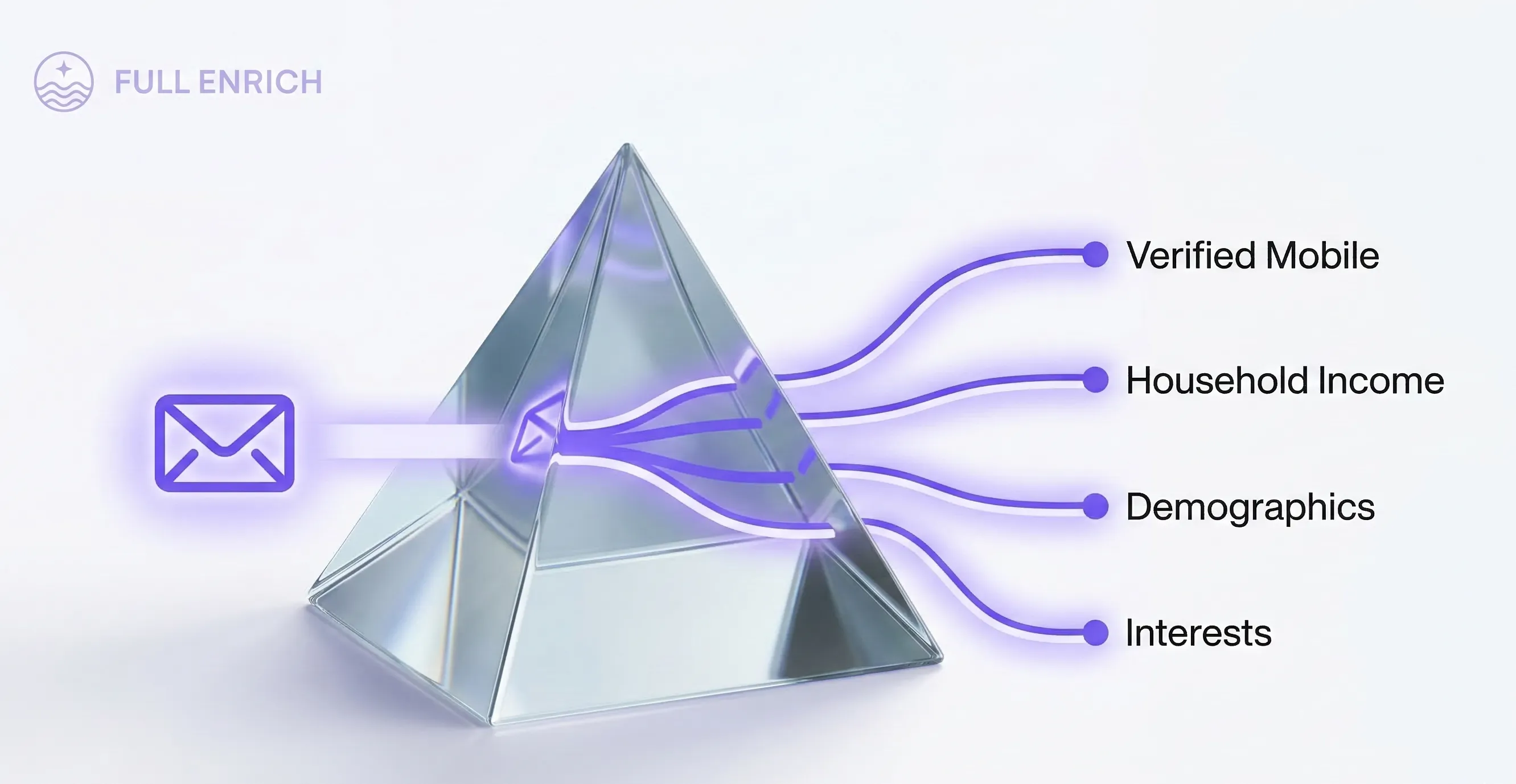

B2C data enrichment enhances consumer records by appending missing attributes from external data sources. When a customer signs up with only an email address, enrichment fills the gaps: phone numbers, mailing addresses, demographic attributes, purchase history, lifestyle signals, and behavioral indicators.
Unlike B2B enrichment, which targets company hierarchies and job titles, B2C enrichment focuses on individual consumer characteristics. Age, household income, family composition, spending patterns, and device preferences are the data points that drive segmentation, personalization, and retention for consumer-facing businesses.
The result is a shift from generic outreach to campaigns that reflect who customers actually are.
What Is B2C Data Enrichment?
B2C data enrichment works by running matching algorithms against third-party consumer databases using the identifiers you already hold. An email address, phone number, or mailing address becomes the input. The enrichment provider searches its network for associated records and returns the matched attributes back into your customer profiles.
The distinction from other enrichment types is important. B2B enrichment fills gaps in business contact records. B2C enrichment builds individual consumer profiles, often starting from a single identifier and returning demographic, behavioral, and transactional context that the customer never provided directly.
Enrichment is not a one-time operation. Consumer data changes continuously as people move, change numbers, start new jobs, or shift spending habits. Ongoing enrichment refreshes records against current databases, removes outdated contacts, and appends new attributes as they become available.
Without it, even a recently built customer database begins decaying within months.
Why Does B2C Data Enrichment is Important?
Most consumer records collected at signup are incomplete by design. Customers enter the minimum required fields and move on. What brands receive is a name and an email. What they need to run effective campaigns is demographic context, verified contact details, and behavioral signals that reveal intent.
According to Litmus Research, nearly 1 in 6 marketing emails never reaches the inbox. A significant share of those failures trace back to invalid or outdated contact data, addresses that were never verified, phone numbers that changed, and email fields that passed format validation but were never active. Enrichment identifies these dead ends before the budget is spent reaching them.
The personalization gap compounds the problem. Customers rarely volunteer their household income, family size, or purchase preferences at signup. Enrichment provides this context without adding friction to the registration experience.
Beyond campaigns, enriched data supports fraud prevention and regulatory compliance. Identity resolution confirms that customers are who they claim to be, reducing chargebacks and account takeovers. Accurate contact records also make it possible to fulfill data access and opt-out requests under GDPR and CCPA within required timeframes.
What Does B2C Data Enrichment Cover?
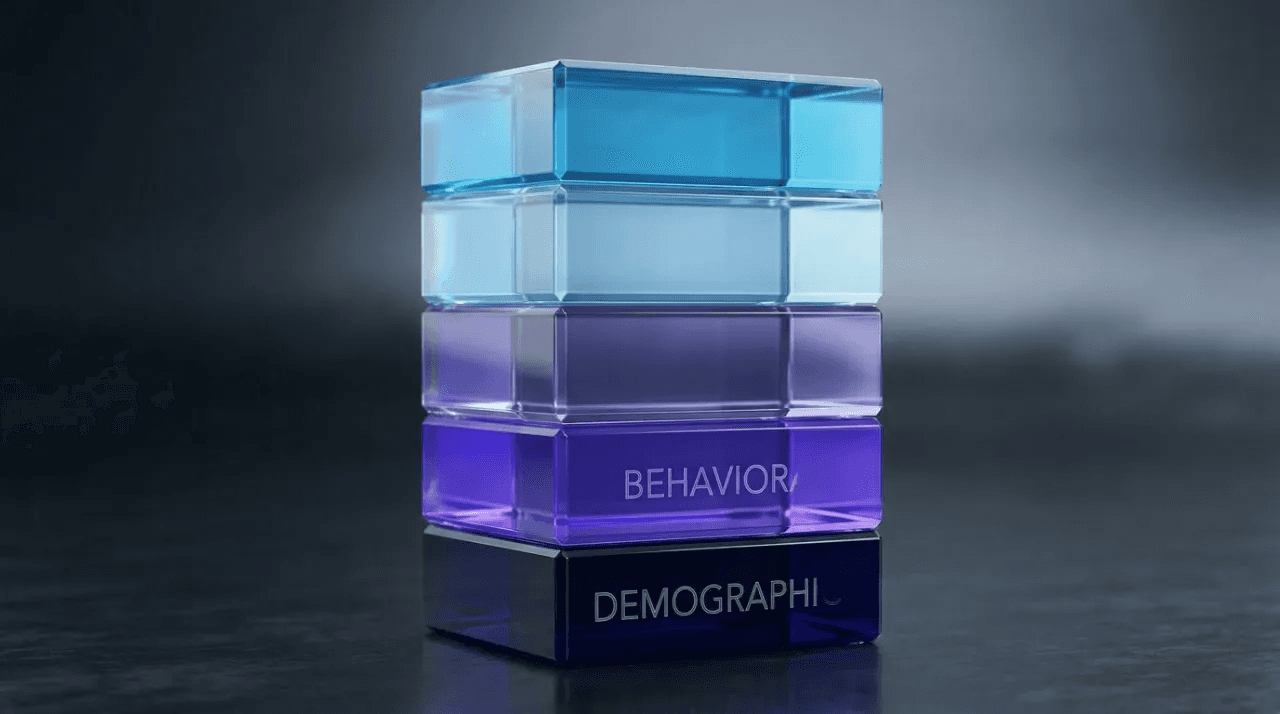
B2C enrichment draws from five data categories. Each serves a different function within the consumer marketing workflow, and the right combination depends on the use case.
Demographic data covers age, gender, income level, education, and household composition. It enables life-stage segmentation: a 28-year-old renting an urban apartment responds differently to a home improvement offer than a 45-year-old homeowner in the suburbs. Geographic precision extends to neighborhood-level attributes, enabling localized offers and region-specific creative.
Contact validation and enhancement verifies email addresses against live mail servers, phone numbers against carrier records, and mailing addresses against postal databases. It also appends missing contact channels, turning an email-only record into a multi-channel profile with a verified phone number and physical address.
Behavioral and psychographic data covers purchase history, browsing patterns, content engagement, and lifestyle indicators such as travel frequency, fitness habits, and entertainment preferences. This layer shows what customers actually do, not just who they are demographically.
Social and digital signals include social profile data, online activity indicators, and life event triggers. A change in relationship status, a job update, or a new interest signal can indicate a shift in purchasing behavior. These signals support timely outreach tied to current circumstances rather than historical snapshots.
Financial and transaction attributes cover spending capacity, credit indicators, and transaction history. Retail brands use this layer to identify high-value customers worth additional retention investment. Subscription services use it to evaluate payment risk before offering long-term contracts.
How Does B2C Data Enrichment Work?
B2C data enrichment moves through three stages: identity matching, data appending, and ongoing refresh. Each stage determines the quality and usability of the output.
Stage 1. Identity Matching
The process begins with the identifiers your system already holds. An email address, a phone number, or a hashed device ID becomes the lookup key. Enrichment providers run this identifier against their consumer databases, searching for associated records across multiple sources.
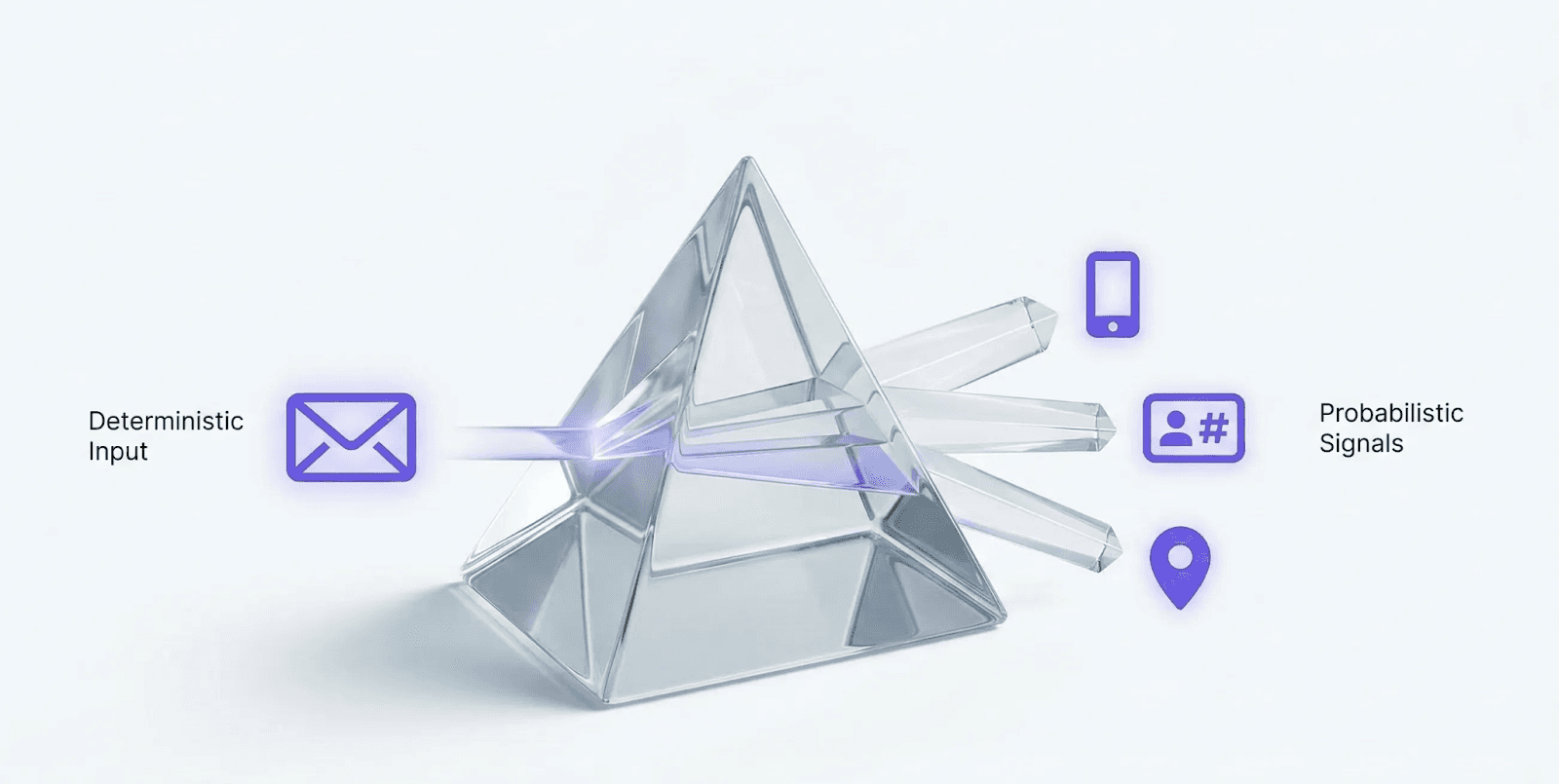
Match quality depends on the identifier type. Verified email addresses and phone numbers produce higher-confidence matches. Probabilistic matching, which infers connections from overlapping signals like shared IP addresses or behavioral patterns, extends coverage to anonymous or incomplete records but introduces some margin of error.
Most platforms use both methods, applying deterministic logic where verified identifiers are available and probabilistic matching where they are not.
Stage 2. Data Appending
Once a match is confirmed, the provider returns the associated attributes to your system through an API connection or batch upload.
Field mapping rules determine which enriched data populates which record fields, and overwrite logic protects manually verified data from being replaced by potentially outdated enrichment output.
Waterfall enrichment improves match rates by querying multiple providers sequentially. If Provider A has strong email coverage but weak phone data, Provider B handles the phone lookups. Provider C covers mailing addresses. The platform cycles through sources until the record is complete or all available sources are exhausted.
This approach consistently produces higher coverage than single-source enrichment, particularly for niche demographics and international audiences.
Stage 3. Ongoing Refresh
Consumer data decays faster than most marketing teams account for. People change jobs, move addresses, and update phone numbers continuously. A database that was 90% accurate at the start of the year will have degraded meaningfully by Q3 without re-enrichment.
Scheduled refresh cycles, typically quarterly for active customers, keep records current without requiring manual intervention.
How FullEnrich Supports B2C Data Enrichment?
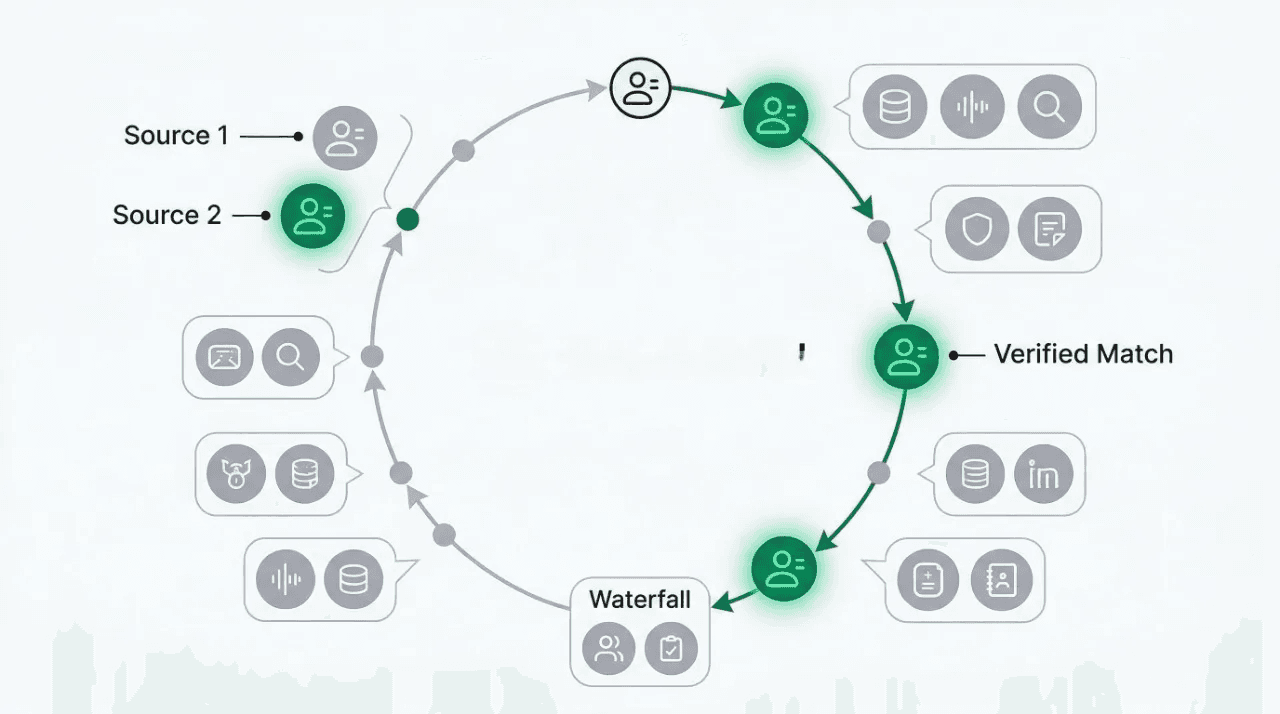
FullEnrich aggregates 20+ premium data providers in a waterfall sequence, querying each source until a verified contact result is returned. For consumer-facing teams, this means email addresses and phone numbers found across provider networks that any single database would miss.
Find rates reach 89% for US emails and 86% for US mobile phones. Triple email verification against live mail server records produces bounce rates under 1%. Credits are charged only on successful enrichment. Failed lookups consume no budget, and there are no seat fees or per-user costs.
Data is fetched on demand with no persistent storage of personal records, keeping operations compliant with GDPR, CCPA, and SOC 2 Type II requirements. Enrichment runs via API, CSV upload, or direct CRM integration for both real-time and bulk workflows.
Start enriching your customer records with FullEnrich →
Key Features:
Waterfall enrichment across 20+ data sources
Email and phone number verification
LinkedIn and social profile enrichment
Real-time API and bulk enrichment options
Multi-channel contact discovery
Best For: E-commerce brands, subscription services, consumer apps, and direct-to-consumer companies needing comprehensive contact enrichment with high accuracy rates.
Conclusion
B2C data enrichment turns incomplete customer records into actionable consumer intelligence. Verified contact data improves deliverability. Demographic and behavioral attributes enable personalization that signup forms cannot produce.
Ongoing refresh prevents the data decay that quietly undermines campaign performance over time. The foundation is choosing a provider with transparent sourcing, strong match rates across your target geography, and compliance posture that matches your regulatory obligations.
Frequently Asked Questions (FAQs)
1. What's the difference between B2B and B2C data enrichment?
B2B enrichment focuses on company hierarchies, job titles, and business contact information, while B2C enrichment emphasizes consumer demographics, household data, and personal contact channels.
2. How accurate is B2C data enrichment?
Accuracy varies by provider and data type, typically ranging from 70-95% depending on source quality, verification methods, and data freshness standards.
3. Is B2C data enrichment legal under privacy regulations?
Yes, when providers comply with consent requirements, maintain opt-out mechanisms, and source data from legitimate channels aligned with GDPR, CCPA, and other regulations.
4. How often should I re-enrich customer data?
Consumer data changes frequently; re-enrich quarterly for active customers and annually for inactive segments to maintain accuracy without excessive processing costs.
5. Can data enrichment improve email deliverability?
Yes, by validating email addresses, removing inactive contacts, and appending missing information, enrichment reduces bounce rates and improves sender reputation metrics.
6. What's waterfall enrichment?
Waterfall enrichment queries multiple data sources sequentially, using the first provider to return results and falling back to alternatives when initial sources lack information.
7. Do I need separate tools for different data types?
Not necessarily; comprehensive providers like FullEnrich cover multiple data categories, but specialized tools may offer superior accuracy for specific attributes like identity verification or social profiles.
8. How much does B2C data enrichment cost?
Costs range from $0.10 to $2.00 per enriched record depending on provider, data depth, and volume, with enterprise contracts offering volume discounts.



Other Articles
Cost Per Opportunity (CPO): A Comprehensive Guide for Businesses
Discover how Cost Per Opportunity (CPO) acts as a key performance indicator in business strategy, offering insights into marketing and sales effectiveness.
Cost Per Sale Uncovered: Efficiency, Calculation, and Optimization in Digital Advertising
Explore Cost Per Sale (CPS) in digital advertising, its calculation and optimization for efficient ad strategies and increased profitability.
Customer Segmentation: Essential Guide for Effective Business Strategies
Discover how Customer Segmentation can drive your business strategy. Learn key concepts, benefits, and practical application tips.